Fraud Awareness Guide

Fraud Awareness Guide

On this page we have outlined useful tips and tricks to stay safe online and to reduce the risk of falling for scams

Introduction

At Donore Credit Union, your security is our top priority, and we are committed to helping you protect yourself from fraud. As fraudsters continue to develop new and increasingly sophisticated methods to target individuals and businesses, staying informed has never been more critical.

.

Fraud can take many forms, from phishing emails to phone scams, and even subtle tactics designed to exploit your personal information online. That’s why we believe it is our responsibility to educate and inform our members about potential threats and provide practical tips for safeguarding your finances and personal information.

.

Below, we have outlined the most common types of fraud, complete with real-world examples and actionable advice, so you can stay one step ahead and protect what matters most. You can also click the button below to view our Fraud Awareness Guide which can be printed and is a good manual for vulnerable family members, friends or neighbours.

See More

Phishing, Smishing & Vishing

Phishing, smishing, and vishing are among the most common scams, each targeting victims through different communication channels. Learn how these scams work and how to spot the warning signs to stay protected.

.

.
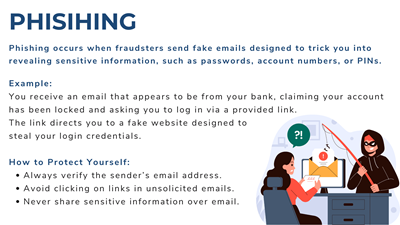
Phishing occurs when fraudsters send fake emails designed to trick you into revealing sensitive information, such as passwords, account numbers, or PINs. Example: You receive an email that appears to be from your bank, claiming your account has been locked and asking you to log in via a provided link.  The link directs you to a fake website designed to  steal your login credentials.  How to Protect Yourself: Always verify the sender’s email address. Avoid clicking on links in unsolicited emails. Never share sensitive information over email.

.

Smishing involves fraudulent text messages sent to your phone, often claiming you need to take urgent action, such as clicking on a link or calling a number. Example: You receive a text message saying, “Your account is overdrawn. Click here to resolve: [fake link].” The link leads to a site designed to steal your information.  How to Protect Yourself: Be cautious of unexpected texts asking for personal      or financial details. Don’t click on links from unknown senders. Contact the organisation directly to verify the      message by using the official contact details.

.

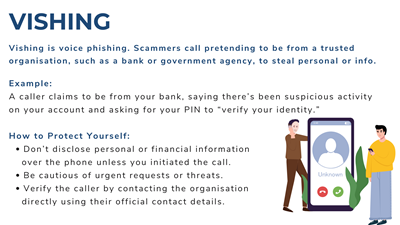
Vishing is voice phishing. Scammers call pretending to be from a trusted organisation, such as a bank or government agency, to steal personal or info. Example: A caller claims to be from your bank, saying there’s been suspicious activity on your account and asking for your PIN to “verify your identity.”  How to Protect Yourself: Don’t disclose personal or financial information      over the phone unless you initiated the call. Be cautious of urgent requests or threats. Verify the caller by contacting the organisation      directly using their official contact details.
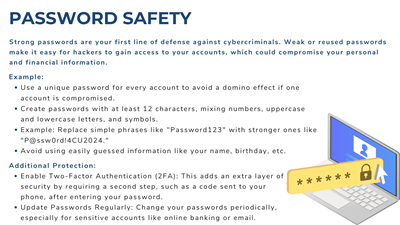
Strong passwords are your first line of defense against cybercriminals. Weak or reused passwords make it easy for hackers to gain access to your accounts, which could compromise your personal and financial information. Example: Use a unique password for every account to avoid a domino effect if one account is compromised. Create passwords with at least 12 characters, mixing numbers, uppercase and lowercase letters, and symbols. Example: Replace simple phrases like "Password123" with stronger ones like "P@ssw0rd!4CU2024." Avoid using easily guessed information like your name, birthday, etc Additional Protection: Enable Two-Factor Authentication (2FA): This adds an extra layer of security by requiring a second step, such as a code sent to your phone, after entering your password. Update Passwords Regularly: Change your passwords periodically, especially for sensitive accounts like online banking or email..
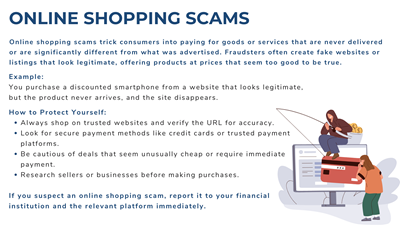
Online shopping scams trick consumers into paying for goods or services that are never delivered or are significantly different from what was advertised. Fraudsters often create fake websites or listings that look legitimate, offering products at prices that seem too good to be true. Example: You purchase a discounted smartphone from a website that looks legitimate, but the product never arrives, and the site disappears. How to Protect Yourself: Always shop on trusted websites and verify the URL for accuracy. Look for secure payment methods like credit cards or trusted payment platforms. Be cautious of deals that seem unusually cheap or require immediate payment. Research sellers or businesses before making purchases.  If you suspect an online shopping scam, report it to your financial institution and the relevant platform immediately.
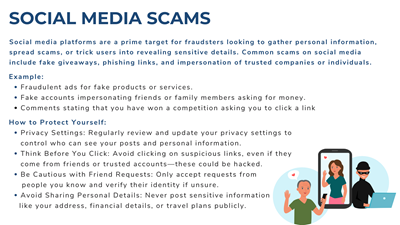
Social media platforms are a prime target for fraudsters looking to gather personal information, spread scams, or trick users into revealing sensitive details. Common scams on social media include fake giveaways, phishing links, and impersonation of trusted companies or individuals. Example: Fraudulent ads for fake products or services. Fake accounts impersonating friends or family members asking for money. Comments stating that you have won a competition asking you to click a link. How to Protect Yourself: Privacy Settings: Regularly review and update your privacy settings to control who can see your posts and personal information. Think Before You Click: Avoid clicking on suspicious links, even if they come from friends or trusted accounts—these could be hacked. Be Cautious with Friend Requests: Only accept requests from       people you know and verify their identity if unsure. Avoid Sharing Personal Details: Never post sensitive information      like your address, financial details, or travel plans publicly.
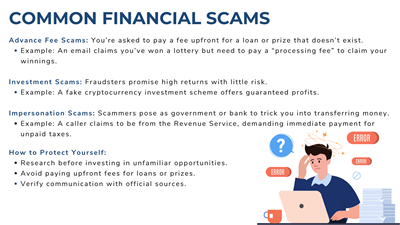
Common Financial Scams Advance Fee Scams: You’re asked to pay a fee upfront for a loan or prize that doesn’t exist. Example: An email claims you’ve won a lottery but need to pay a “processing fee” to claim your winnings.  Investment Scams: Fraudsters promise high returns with little risk. Example: A fake cryptocurrency investment scheme offers guaranteed profits.  Impersonation Scams: Scammers pose as government or bank to trick you into transferring money. Example: A caller claims to be from the Revenue Service, demanding immediate payment for unpaid taxes.  How to Protect Yourself: Research before investing in unfamiliar opportunities. Avoid paying upfront fees for loans or prizes. Verify communication with official sources.

What to Do If You Fall Victim to Fraud

If you suspect you’ve fallen victim to fraud, it’s important to act quickly to minimise the potential damage.
Here’s what you should do:

.

1. Stop and Think:

If you realise you have provided sensitive information or made a payment to a scam, do not panic.
Take immediate steps to protect yourself.

.

2. Contact Your Bank or Credit Union:

Report the issue to your bank or credit union as soon as possible. They can help secure your accounts, stop unauthorised transactions, and guide you on the next steps.

If you’ve shared your card details, ask to have the card blocked or replaced to prevent further fraudulent charges.

.

3. Change Your Passwords:

If your online accounts have been compromised, immediately change your passwords to strong, unique ones. Use a combination of letters, numbers, and symbols, and avoid reusing passwords across accounts.

.

4. Report the Fraud to Authorities:

Report the incident to the Gardaí or your local law enforcement agency. They may be able to investigate the scam further.

.

5. Notify Relevant Services or Platforms:

If the scam occurred on an e-commerce site, or through a specific app, report the fraudulent account or activity to the platform. Many services have fraud reporting mechanisms in place.

.

6. Monitor Your Accounts:

Keep a close eye on your bank statements, credit card transactions, and any online accounts to catch unusual activity early.

By acting quickly and taking these steps, you can mitigate the effects of fraud and prevent further issues.

.

For further information about fraud awareness, visit FraudSmart.ie

FraudSMART raises awareness of financial scams and provides tips on how to protect yourself.
Developed by Banking & Payments Federation Ireland in collaboration with member banks.


Click Here to See More